For most freelancers, small agencies and small businesses in Pakistan, you do not need a CRM consultant. You need a simple CRM, a clear afternoon, and a bit of guidance getting your first leads in. CRM consulting, implementation and development services exist for a reason, but they solve problems that a five person team with a WhatsApp inbox and a spreadsheet usually does not have yet. This guide explains what each of those services actually means, what to watch for on cost, when hiring help is the right call, and how to set up a working CRM yourself in a single day.
What CRM services actually mean
When you search for CRM services, you will see four terms used almost interchangeably. They are not the same thing, and mixing them up is how small businesses end up paying for work they never needed.
CRM consulting
Consulting is advice. A consultant looks at how your sales and client process works today, suggests what to change, and recommends a tool. It makes the most sense for companies with several departments, long sales cycles, or a messy process that nobody has written down. For a solo freelancer or a three person agency, the process is usually simple enough that the consultant's main output would be a document you could have written yourself.
CRM implementation
Implementation is the actual setup: creating pipeline stages, importing contacts, configuring fields, and training the team. With a large platform like Salesforce or Dynamics, this can take weeks and often needs a specialist. With a lightweight CRM built for small teams, it is closer to an hour of work.
CRM integration
Integration means connecting the CRM to other software, such as accounting systems, email platforms, ERP tools or a website. This is a genuine developer task, and it is where outside help is most often worth paying for, but only once you actually have a second system that needs to talk to the first.
Custom CRM development
Custom development means building a CRM from scratch for one company. It gives you full control, but it also means paying for design, code, hosting, bug fixes and every future change. It tends to make sense for businesses with unusual workflows that no ready made product can handle, not for a small team that simply wants to stop losing leads.
What these services cost, and where small businesses get surprised
Prices for CRM services in Pakistan vary a lot depending on the provider, the platform and the scope, so it is better to understand the shape of the cost than to chase a single number.
The costs that are easy to miss
- Scope creep. A quote that covers setup rarely covers the changes you will want after your team starts using the system. Each change request becomes another invoice.
- Licence fees on top. Many large platforms charge per user per month, usually in US dollars, whatever you pay the consultant.
- Training time. A complicated setup means your team spends days learning it, and adoption often drops if it feels heavy.
- Ongoing support. Custom builds and heavy configurations need someone to maintain them, which usually means a retainer or a call out fee.
The question behind the cost
The real question is not how much a consultant charges. It is whether the problem you are paying them to solve actually exists in your business. If your real problem is that leads get forgotten and follow ups slip, a full implementation project is a very expensive answer to a very simple question.
When you genuinely need a consultant or developer
There are real situations where outside help pays for itself. Consider hiring a specialist if:
- You have several teams or branches that need different views of the same customer data.
- You need the CRM to exchange data with accounting, ERP, a custom website or a payment system.
- You are migrating thousands of records from an older system and need them cleaned and mapped correctly.
- Your sales process involves approvals, compliance steps or complex pricing that a standard pipeline cannot model.
- You operate in a regulated field where data handling has to follow specific rules.
If none of these describe you, the next section is probably closer to your situation.
When you can just start today
Solo freelancers and small agencies
If you are one to five people, your process is likely some version of: find a lead, talk to them, send a proposal, win or lose, then manage the client. That fits a simple pipeline without any customisation. A tool built for exactly this, such as The Little CRM for freelancers or the CRM for marketing agencies, already has those stages and fields in place.
Teams with a simple, repeatable process
Consultants, coaches, designers and small local businesses tend to sell the same few services over and over. If you can describe your process in four or five steps, you can set up a CRM without help. If you run a small business or a startup with a lean team, starting simple and adding complexity only when you feel the need is almost always the cheaper and faster path.
A working CRM setup in one afternoon
Here is a practical way to go from scattered chats and spreadsheets to a working system in a few hours.
Step 1: List where your leads come from
Write down every source: WhatsApp messages, referrals, Google Maps outreach, social media, a website form. This tells you what you need to capture and helps you see which channels actually produce clients.
Step 2: Define four or five pipeline stages
Keep it short. A sensible set is new lead, contacted, proposal sent, won and lost. If you want a deeper explanation of how stages work, see our guide on what a sales CRM is and how pipeline stages work.
Step 3: Add your current leads and clients
Start with the people you are actively talking to, not your entire contact history. Twenty to fifty real leads are enough to make the system useful from day one. Cleaning old data can wait.
Step 4: Put a follow up date on every lead
This single habit does more for your conversion rate than any other feature. Every lead should have a next action and a date. When the date passes, the CRM should flag it.
Step 5: Review once a week
Spend fifteen minutes every week looking at what is overdue, what is stuck and what closed. That review is where a CRM stops being a database and starts being a tool.
How The Little CRM replaces the setup service
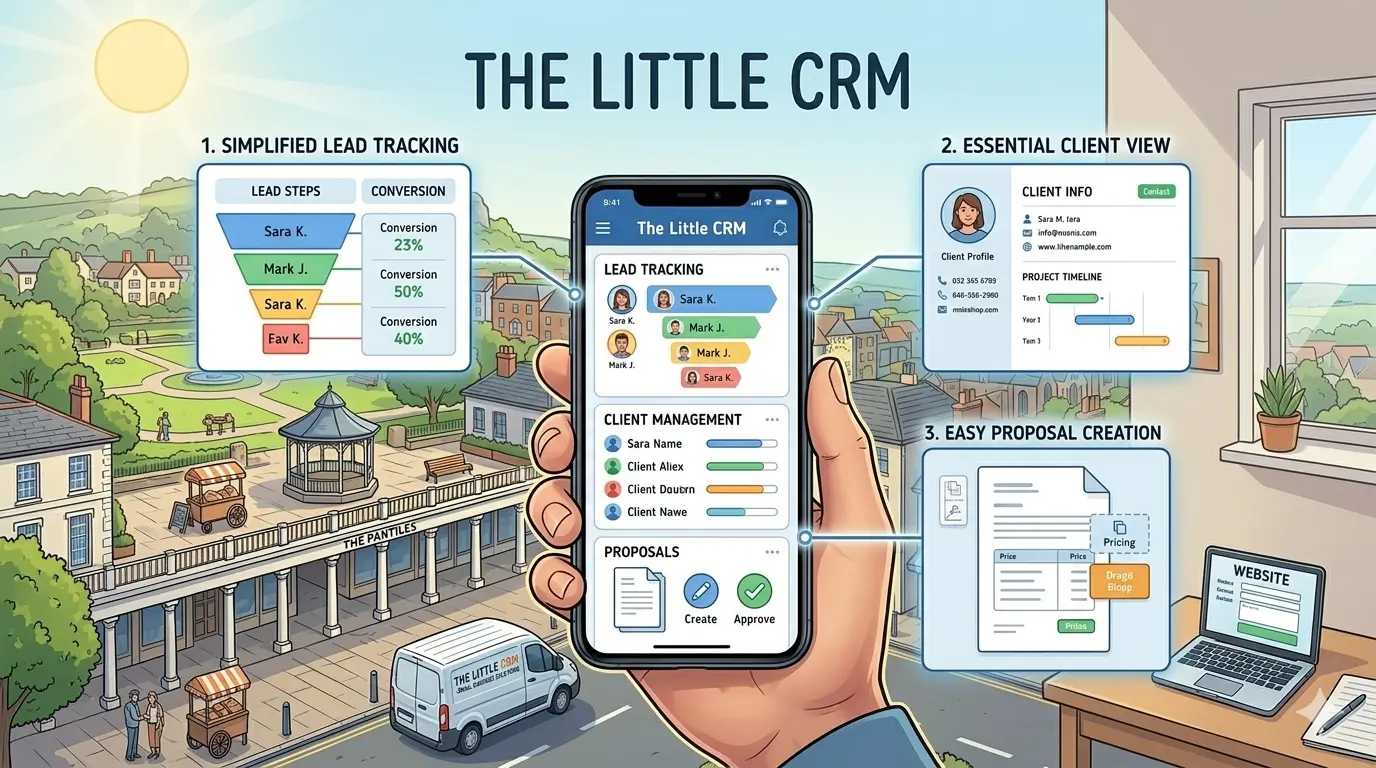
The Little CRM was built so that most small teams never need a consultant. Pipeline stages, client tracking fields, follow up alerts and monthly reports are already in place, so there is nothing to configure before you start. If you would like a hand, onboarding happens over WhatsApp with a Lahore based team, and accounts are usually ready within the hour. That covers the part of implementation that actually matters to a small business: getting your first leads in and knowing where to click.
You can read how the product works, try it on the free 7 day trial with no credit card, or look at the plans, starting at PKR 599 a month. If you want to see how a simple tool is explained in plain terms first, our original post on how The Little CRM manages leads, clients and proposals is a good starting point. And if you are weighing up free options before committing, our guide to free CRM options for small businesses in Pakistan lays out what free really includes.
If your needs outgrow a simple tool later, because you need a deep integration or a custom workflow, that is the moment to bring in a developer. By then you will also know exactly what you want built, which makes the project cheaper and faster.
Questions to ask before hiring any CRM consultant
- What exact problem will this project solve, and how will we measure whether it worked?
- Is the quote fixed, or does every change cost extra?
- Which CRM platform will you recommend, and do you earn a commission on it?
- Who owns my data and the configuration if we stop working together?
- What will my team need to learn, and how long will that take?
- Is there a simpler tool that would solve this without a project at all?
Frequently asked questions
Do small businesses in Pakistan need a CRM consultant?
Usually not. A freelancer, small agency or local business with a simple sales process can set up a ready made CRM in an afternoon. Consultants become useful when you have multiple teams, complex approvals or heavy integrations.
What is the difference between CRM implementation and CRM integration?
Implementation is setting up the CRM itself, including stages, fields, imports and training. Integration is connecting the CRM to other software such as accounting tools, email or a website.
Is custom CRM development worth it?
Only when your workflow is unusual enough that no ready made product can handle it. For most small teams, a ready made CRM costs far less to run and does not need ongoing developer support.
How long does it take to set up a simple CRM?
With a lightweight CRM built for small teams, a basic setup takes a few hours. Large platforms with heavy customisation can take weeks.
Does The Little CRM offer setup help?
Yes. Onboarding is handled over WhatsApp by a Lahore based team, and most accounts are ready within the hour. There is a free 7 day trial with no credit card required.